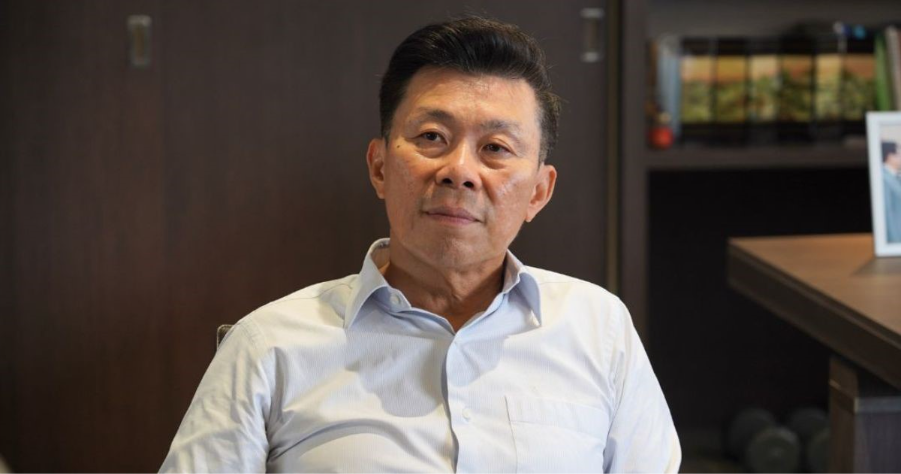
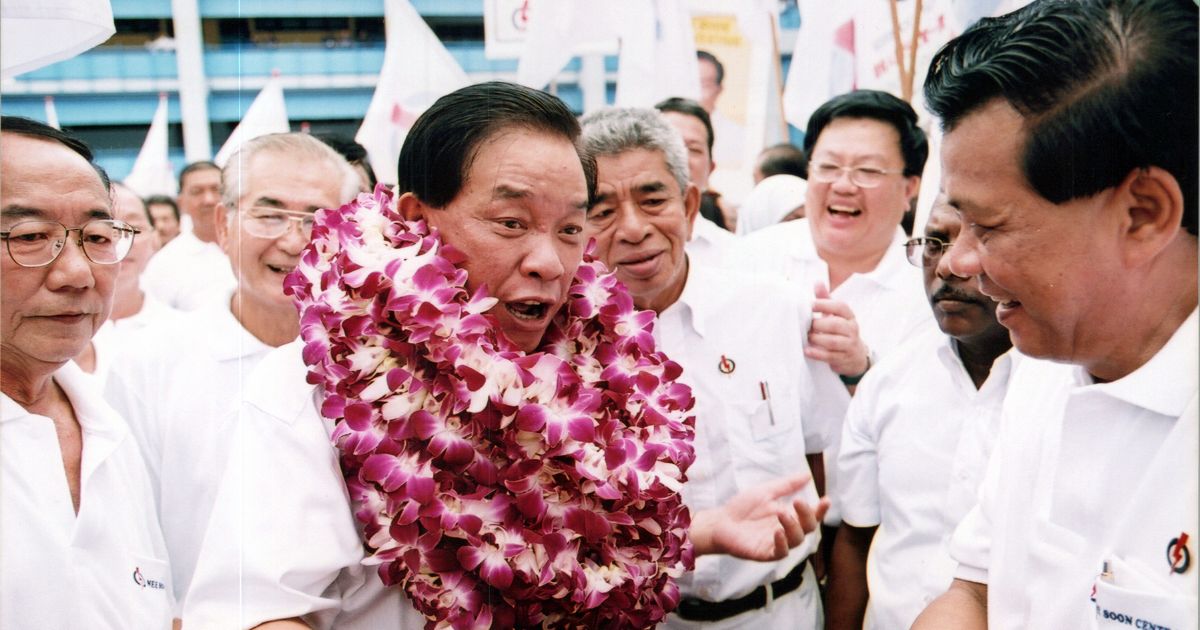
Comrade Ong Ah Heng passed away on 5 May 2026. He was 84 years old.
In coffeeshops around Nee Soon Central, residents still remember Comrade Ong fondly as their very own “Kopitiam MP”. He served Nee Soon Central as their MP from 1997 to 2011, when it was still a Single Member Constituency (SMC).
A friendly, jovial presence in their coffeeshops, he helped solve issues facing his working-class residents, raising their bread-and-butter concerns up to the halls of Parliament in his booming Mandarin baritone.
Befriending all, residents and secret society members alike
Comrade Ong joined the PAP in 1964, before Independence, and his lifelong commitment to our party’s principles are best exemplified in his work for the community.
Comrade Ong’s concern for the working class led him to make unconventional acquaintances — members of the secret societies who lived in the neighbourhood. He knew that they too had problems and issues, and would give him real, unvarnished feedback about the neighbourhood, so he built up relationships with them.
“Ang Soon Tong was the main society. There was also Tiong Yee Tong and Hai Lok San. I had some of my contacts introduce me to the leader of Ang Soon Thong. Initially they were quite friendly, but had their reservations about me because I was new,” he recounted in Shashi Jayakumar’s A History of the People’s Action Party, 1985-2021.
“Only when they were confident that I would not betray their trust did they become friendly with me as someone they could surface their concerns with.”
Comrade Ong’s concern for the working class took centre stage in his response to the 2006 President’s Address.
“As Members of Parliament, we have the duty to do our best to take practical action to look after the less fortunate and weaker residents in our constituencies,” he said in Mandarin. “This is something we need to do.”
“The Government should plan and coordinate the various assistance schemes of the various Government departments, and review the application procedure and regulations in order to minimise red tape and bureaucracy,” he added, wanting to make sure that his fellow Singaporeans who needed help the most — the aged and the less-educated — could access it easily and without stress.
Speaking up for the working class
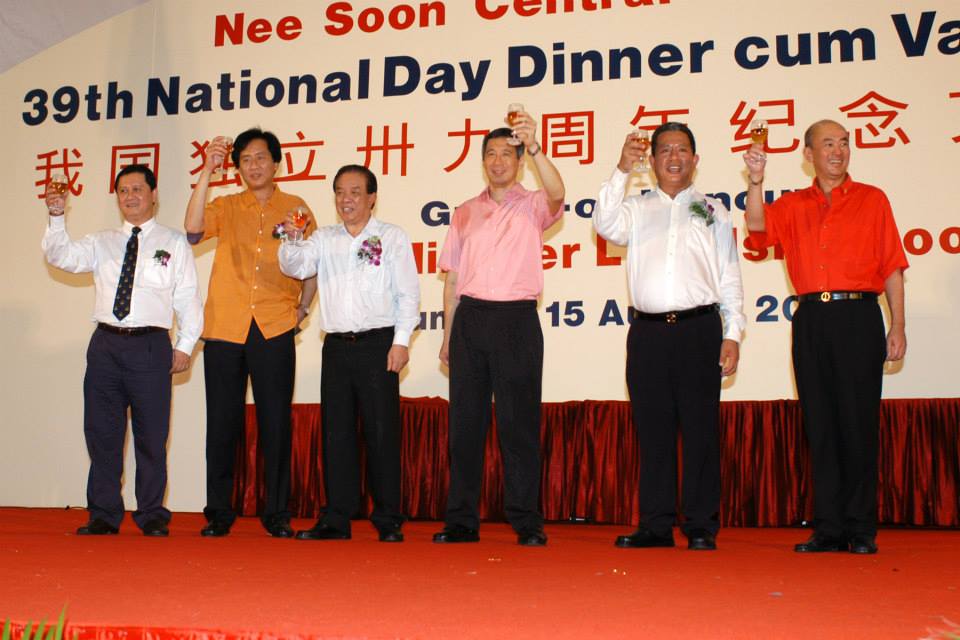
Source: Lee Hsien Loong / Facebook
Comrade Ong’s name comes up in the Hansard 117 times. In his usual frank manner, he asked the Minister of Labour to “prevent employers from using the regional currency crisis as an excuse to get rid of Singaporean workers. Especially the older ones” (Feb 1998).
He pushed the Minister for Trade and Industry to provide more apprenticeship training places for ITE (Institute of Technical Education) and vocational institute students.
He was keen to have the Ministry of Manpower ratify the International Labour Organisation’s Convention 100 on “Equal Remuneration” so that women could get equal pay as men for the same work done (Aug 1999).
In Nee Soon Central, he strongly pressed the Ministry of Health to convert Yishun Medical Centre into a full-fledged polyclinic (Feb 1997). The Ministry agreed, giving Yishunites a one-stop centre for outpatients, as well as for maternal and child care.
Ministers sat up and listened whenever Comrade Ong spoke, former Deputy Prime Minister Tony Tan once remarked. They knew that his voice was the voice of the working class, and that his concerns were authentically — and pressingly — from the ground.
Comrade Ong’s efforts for workers and Nee Soon Central left a lasting impression in the hearts and minds of his residents.
His first-ever vote share, in the General Election (GE) 1997, was 61.3 per cent — an 11.6 per cent swing away from the opposition candidate from the SDP, which historians attribute to his exceptional outreach on the ground in Nee Soon Central.
His next, in GE 2001, was 78.5 per cent; candidates from that opposition party have not contested in Nee Soon ever since, a testament to the strong foundations that Comrade Ong built with Nee Soon residents.
Five years after his retirement from politics, he strode in his Party whites to the speaker’s podium once more, stumping strongly for the PAP at our GE 2015 rally in Nee Soon. Roars, cheers, and celebratory horns from the crowd greeted him.
“A certain aura”
Minister K Shanmugam, who is also MP for Nee Soon GRC, paid tribute to Comrade Ong.
“He often spoke from lived conviction. He once said he owed much to our meritocratic system. It allowed him to start as a construction worker, and go on to obtain a master’s degree. He became an effective unionist,” said Mr Shanmugam, who is also Minister for Home Affairs and Coordinating Minister for National Security.
“He believed in staying close to the ground. Close to the people. I have had the privilege of knowing him for many years. I will miss him.”
“My own memories of Comrade Ong go back to my younger days in the labour movement. From afar, he carried a certain aura. You sensed immediately that he belonged to a generation of unionists who had fought many battles and earned their respect the hard way,” said Mr Alex Yam, MP for Marsiling Yew-Tee GRC.
Away from politics, Comrade Ong was a major figure in the National Trades Union Congress (NTUC), including being the Executive Secretary of the National Transport Workers’ Union from 1981 until 2006.
He retired from the board of ComfortDelGro in May 2020.
Comrade Ong leaves behind his wife, Ms Yeo Siew Eng and a son, Comrade Ong Teng Koon, who was MP for Sembawang GRC and later Marsiling Yew-Tee GRC between 2011 and 2020. He also leaves behind a goddaughter, daughter-in-law and two grandchildren.
His wake is being held at Block 204, Ang Mo Kio Avenue 3, SG 560204 until 10th May.
Rest well, Comrade Ong.