Budget 2026 comes at a pivotal moment for Singapore — as AI reshapes industries, geopolitical uncertainty weighs on the global economy, and our workforce continues to age. Against this backdrop, Labour MPs reaffirmed a clear commitment: the Labour Movement will safeguard workers’ jobs, strengthen their skills, and support every worker to be AI-ready.
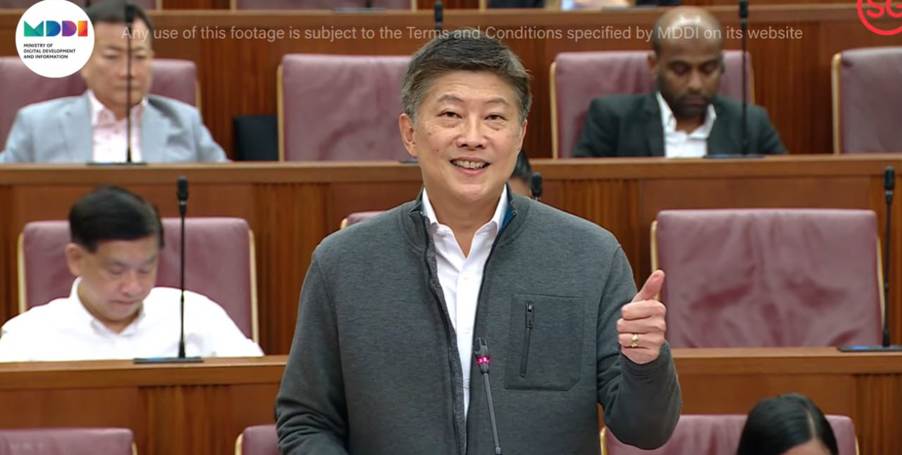
NTUC Secretary-General Ng Chee Meng framed his speech around a “disrupted age” where workers already feel the strain of rising costs, job insecurity and rapid technological change.
He called for urgent action to make every worker AI-Ready, backing the proposed National AI Council chaired by Prime Minister Lawrence Wong and urging clearer national guidance on AI skills and industry roadmaps.
Mr Ng outlined NTUC’s AI-Ready SG initiative — funding AI tools, expanding tailored training pathways, strengthening career mentorship and enhancing AI-powered job matching so upskilling leads to real jobs and progression.
Beyond skills, he stressed the need to strengthen the tripartite compact. He called for reviewing the income cap for the SkillsFuture Jobseeker Support Scheme to the PMET median monthly income, which was approximately S$7,600 in 2025, refreshing caregiver support, and institutionalising advance retrenchment notifications so unions can intervene earlier — especially to protect PMEs.
AI transformation must be inclusive and anchored in strong tripartite cooperation so workers are never left to navigate change alone.
Melvin Yong: Sustaining wage growth for lower-wage workers

NTUC Assistant Secretary-General Melvin Yong highlighted that lower-income workers saw strong gains over the past decade, driven by policies such as the Progressive Wage Model (PWM).
However, recent data shows median wages beginning to outpace lower-wage growth again — a trend that could widen gaps if left unchecked.
He welcomed the increase in the Local Qualifying Salary from S$1,600 to S$1,800 but called for more transparent benchmarking and a predictable schedule of future increases. He also urged extending the PWM Bonus to all PWM sectors, refining support through the Progressive Wage Credit Scheme, and expanding PWM coverage.
Sustained wage growth, he stressed, is the way to ensure Singapore progresses together in the age of AI.
Patrick Tay: Supporting the “5 Us” through disruption

NTUC Assistant Secretary-General Patrick Tay focused on five vulnerable groups — the “5 Us”: the Unemployed, Under-Employed, Under-Represented, Untrained and Under-Served.
He called for advanced Mandatory Retrenchment Notifications so unions can step in early, enhancements to the SkillsFuture Jobseeker Support Scheme, and closer tripartite monitoring of underemployment.
He also urged expanding GRaduate Industry Traineeships (GRIT) into higher-value growth sectors, updating employment laws to reflect workforce realities, and extending support schemes to help ex-offenders remain employed.
Economic transition must not leave workers exposed — protections must evolve alongside disruption.
Desmond Choo: Fixing the “broken rung” for young workers

Minister of State and NTUC Deputy Secretary-General Desmond Choo warned that AI is eroding traditional entry-level roles — creating a “Broken Rung” that risks hollowing out Singapore’s future management pipeline into a “Missing Middle” of senior experts and algorithms.
Citing NTUC survey data showing young workers are most anxious about AI displacement, he argued this weakened incentive to hire juniors is a market failure requiring policy response.
He proposed incentivising AI-integrated apprenticeships with government co-funding, equipping students early with AI literacy and core human skills, and accelerating reskilling through expanded place-and-train pathways.
Without deliberate intervention, he cautioned, upward mobility for the next generation could be compromised.
Yeo Wan Ling: Inclusion must be lived, not just legislated

NTUC Assistant Secretary-General Yeo Wan Ling outlined three priorities: inclusive workplaces for women, kinder workplaces for Persons with Disabilities (PwDs), and responsible AI preparation.
She stressed that policy must be matched by cultural change. Many women, especially caregivers and mid-life workers, still fear stigma when requesting flexibility. She called for expanded job redesign funding, sectoral benchmarks, and clearer guidance on perimenopause and menopause.
On disability inclusion, she urged operationalising the Enabling Mark as a workplace norm, building a national database of inclusive employers, and issuing clearer guidance on best practices.
On AI, she emphasised careful job analysis — particularly in frontline sectors like transport — so technology augments workers with proper safeguards. Transformation, she said, must be just and fair.
Dr Wan Rizal: Building clarity, early engagement and confidence through transition

In his first Budget Debate as a Labour MP, Dr Wan Rizal welcomed Budget 2026’s focus on preparing Singapore for economic transformation in the age of AI.
He observed that workers experience transitions differently — from youth entering the workforce, to mid-career caregivers, seniors wishing to continue contributing, and displaced workers facing uncertainty.
Across these groups, concerns converge on three pillars: clarity, early and trusted engagement, and confidence.
He called for stronger alignment between training and job matching through the SkillsFuture Singapore–Workforce Singapore merger, earlier employer-union engagement during restructuring, and wider adoption of Company Training Committees (CTCs) to ensure job redesign happens with workers, not after them.
Desmond Tan: Harnessing AI to strengthen an ageing workforce

Wrapping up the Labour MPs’ calls, Senior Minister of State and NTUC Deputy Secretary-General Desmond Tan spoke about the “Two AIs” shaping Singapore’s future — Artificial Intelligence and Ageing Individuals.
While AI brings speed and efficiency, he stressed that experienced workers contribute judgement and wisdom which technology cannot replace.
He acknowledged progress in senior employment and retirement adequacy but noted challenges such as age discrimination and slower re-employment for older workers. He called for worker-centric AI adoption, more job redesign, flexible work options and stronger cross-generational career pathways.
In closing, he urged tripartite partners to work together so AI augments experience rather than sidelines it — enabling seniors to age with dignity, security and purpose.
Through strong tripartite cooperation, the Labour Movement is working to safeguard jobs, strengthen skills and support workers to be AI-ready — ensuring transformation translates into opportunity, not insecurity.
Budget 2026 sets the direction. The real test now is turning policy into lived outcomes — building an economy where every worker can adapt with confidence, progress with dignity, and see a secure path forward in Singapore’s AI-enabled future.