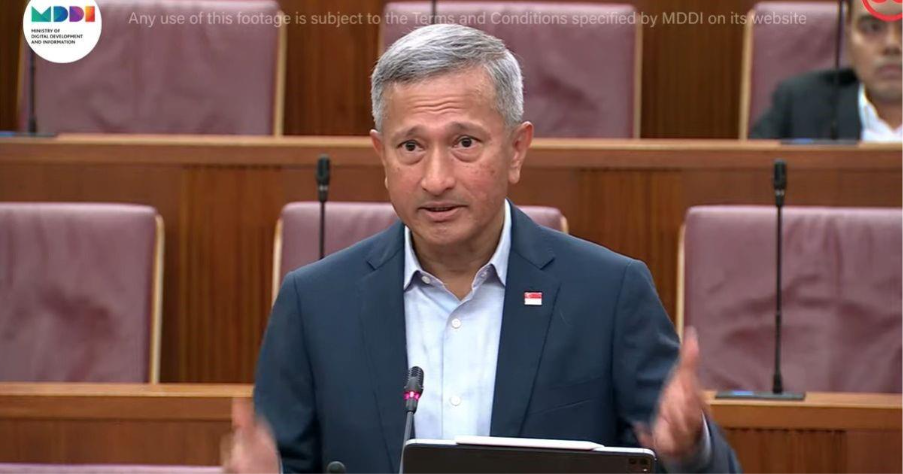
Singapore must retain its ability to say “no” even if it has to pay a price for staking out its position on issues, Foreign Affairs Minister Vivian Balakrishnan said on Feb 27.
Speaking in parliament as he laid out his ministry’s priorities for the year, Dr Balakrishnan noted that Singapore’s interests will not always be aligned with the great or middle powers, or its immediate neighbours as it faces more strategic dilemma and difficult choices in a tumultuous world.
“On some issues, we will have to say ‘no’, to say ‘no’ courteously, respectfully and constructively. This is not about choosing sides, but about upholding principles and a careful assessment of Singapore’s long-term national interests.”
“If we ever lose that ability to say ‘no’, then that is the day that Singapore loses its relevance, indeed, our independence,” he added.
Singapore has a proven track record of staking out our position, which can sometimes come with a price, he added.
He cited past examples where Singapore has taken principled stands: calling out violations of international law, including Russia’s invasion of Ukraine and the US’ actions in Venezuela.
“We took these stands because a world based on ‘might is right’ is more dangerous for Singapore,” he said.
On the Israel-Gaza conflict, he said that Israel’s military response has breached international humanitarian law.
Dr Balakrishnan said that as a small state, Singapore must try to shape its environment and carve out conditions most conducive for its survival and success.
“We want to be useful but not made use of,” he said. “We may be small, but we have agency, we have resilience, and we have the resources and the will to back this up.”
Dr Balakrishnan said his ministry will do this by engaging all great powers constructively and giving them a stake in the stability and prosperity of the region, as this provides small states like Singapore with room to manoeuvre.
On navigating relations with the US and China, he said that Singapore wants to work with both countries where interests coincide.
“The reality is that every country will have to find creative ways to work with both the US and China.”
Dr Balakrishnan pointed out that Singapore is in far better position today to deal with the challenges. It has the prerequisites for success: domestic unity, economic relevance and defence capabilities.
“As long as we understand that we are all in this together, as long as we can inoculate ourselves from foreign influence, as long as we can disagree maturely and ultimately, still forge a domestic consensus, we will continue to thrive. We cannot be bought or bullied by anyone.”
Singapore’s economic vitality and relevance as a “trusted, stable hub” cannot be taken for granted and must be preserved, he noted.
Singapore’s ability to defend itself due to its steady investment in defence for decades, must also be preserved.
“We must preserve this capability because it keeps us safe – and we are a country that can hope for the best but also prepare for the worst,” he said.