SINGAPOREANS OF all ages will have improved online trust and safety, both at home and at work. The PAP Government will work with social media providers to enhance children’s protection against sexual and violent content. For cybersecurity, more secure routers are being mandated for homes.
On the macro level, the new Institute of Digital Government (IDG) will equip over 150,000 public officers with digital, data and design skills. The new National Artificial Intelligence Impact Programme (NAIIP) will help 10,000 enterprises gain AI fluency.
Leaders from the Ministry of Digital Development (MDDI) announced these major AI measures during the Committee of Supply debates this week (2 Mar). The announcements followed timely calls from PAP MPs, such as Christopher de Souza (Holland-Bukit Timah GRC) and Choo Pei Ling (Chua Chu Kang GRC) about harnessing AI for the public good.
Speaking up, and protecting children online
Stronger guardrails will protect children against online harm, said Minister of State for Digital Development and Information Rahayu Mahzam. The upcoming Online Safety Commission fights online harms like harassment and child abuse images. It can issue directions to disable harmful online content or restrict a perpetrators’ online account.
The Online Safety Code for social media services (SMS) currently exists, reminded SMS Rahayu. The Code includes preventing online harm to children, and can issue fines of up to $1 million.
“We will not hesitate to take designated social media services to task if they have failed to comply to the SMS Code,” said MOS Rahayu, mentioning X’s Grok chatbot, which is infamous for being able to manipulate images of people into pornography. “We are also studying whether safeguards for AI chatbots are needed to better protect users from the harms caused by their misuse.”
Her assurance followed a strong call from MP de Souza to balance Singapore’s adoption of AI with protection from AI.
“There must be clear out of bound markers,” said MP de Souza. “No deepfakes, no deepfake pornography, no scams, no deception, no misrepresentation, and no trespass on certain protected IP [intellectual property].
“If Singapore can be an engine for AI adoption while retaining its status as a trusted IP hub, we would have struck the right balance.”
Sharael Taha presses for increased cybersecurity measures
Source: MDDI / YouTube
To boost everyday cybersecurity for Singaporeans, home routers will require Cybersecurity Labelling Scheme Level 2 by 2027.
Level 2 routers have more secure communications and data storage, more robust authentication mechanisms. With the home becoming a key staging point for cyberattacks, the Level 2 routers are a better defence against threats.
“Last year, attackers infected over 2,700 devices such as baby monitors and routers,” said Senior Minister of State for Digital Development and Information Tan Kiat How about a global hacking attack which included Singapore. “When such personal devices are hacked, citizens’ privacy can be compromised and their daily activities disrupted.”
“These devices can also be used unknowingly to launch attacks against others,” he warned.
The Ministry will also help Singapore’s Critical Information Infrastructure (CII) owners “level up”, said SMS Tan. CII deliver essential services across Singapore, including energy, water, finance and transport,
The Ministry will share classified threat intelligence as well as threat detection systems with CII owners.
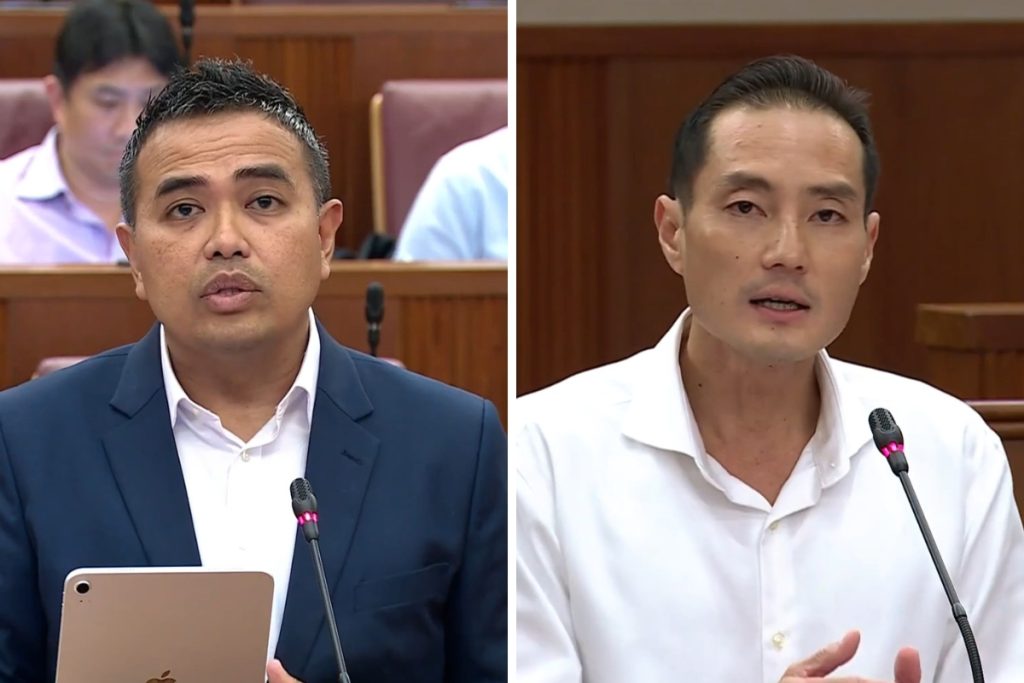
Earlier in the debate, MP Sharael Taha (Pasir-Ris Changi GRC) pressed home the need for increased cybersecurity measures for homes, governments and businesses.
“In a world of escalating digital conflict, resilience is not optional,” he said. “Trust in our digital economy depends on our ability to defend it.”
“We must ensure that as Singapore digitises at scale, our cybersecurity posture strengthens at equal speed.”
Choo Pei Ling foregrounds the human factor in AI

Source: MDDI / YouTube
MDDI will establish the Institute of Digital Government (IDG) together with the Civil Service College at Buona Vista. The IDG will train over 150,000 public officers and leaders in AI and digital transformation for the public good.
“We will focus not just on technology, but on designing solutions that are citizen-centred and secure,” said Minister of State for Digital Development and Information Jasmin Lau.
“Leaders set the conditions,” she added about how the IDG builds AI capability for Singaporeans and the public service. “When they understand the digital landscape, they can guide change confidently and ask their teams the right questions.”
The National AI Impact Programme (NAIIP) will support 10,000 enterprises to adopt AI, and deepen the AI fluency of 100,000 workers. For example, business leaders can have a bootcamp to develop an AI project hands-on. Accountants can join a technology skills programme to automate manual tasks like financial reporting and learn responsible AI use and data governance.
“We believe AI should not replace the discerning human mind,” said Minister for Digital Development and Information Josephine Teo. “Our new Model Governance Framework for Agentic AI will help organisations manage systems that can act with greater independence, whilst ensuring human oversight.”
Singapore is the first government worldwide to introduce such guidelines.
MDDI’s assurance that it will use AI in a humanist, contextual manner came after MP Choo Pei Ling (Chua Chu Kang GRC) reminded Parliament about the human factor in large-scale AI use.
“We will need more than AI engineers. We will need people fluent in both domain and data, professionals who understand context, model limits and risk,” said MP Choo. “The future workforce must be fluent in both code and context.”
“If we build value, trust and bilingual talent, Singapore will not merely adopt AI. We will shape how it is deployed and ensure that our growth is resilient and inclusive.”