60 years ago, Singapore became “forever a sovereign democratic and independent nation” when we separated from Malaysia.
But what were the events leading up to it?
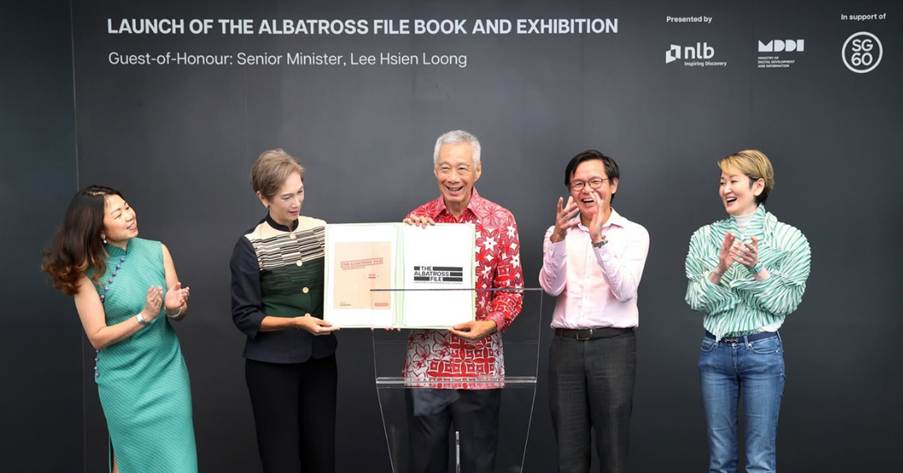
The publishing of a book on the Albatross File – documents and notes kept by Dr Goh Keng Swee leading up to that pivotal moment – has given us a peek into history and how Singapore came to be.
At the launch of the Albatross File Book and Exhibition, Senior Minister Lee Hsien Loong shared his thoughts on the perennial question – was Singapore kicked out?
Here are extracts from SM Lee’s speech:
The key question concerning Separation is this: “Was Singapore kicked out by Malaysia, or did we seek Separation?” Originally, the prevailing view was: “We were kicked out”.
The Tunku himself said at the time that the decision to kick Singapore out of Malaysia had been taken by him, solely.
But of course such an earthshaking – and at that time, unexpected – outcome could not have had a simple or singular cause. The Tunku certainly was a decisive figure in Separation. But many factors forced his hand and led him to conclude that letting Singapore go was the best option, for him and for Malaysia.
Not least was the intense political campaign that Mr Lee (Kuan Yew) and others in the Singapore leadership mounted to fight for a “Malaysian Malaysia”.
So, Mr Lee brought enormous political pressure to bear on the federal government.
Those were very tense days. Mr Lee was aware that the federal authorities were considering arresting him, and that he was in grave peril.
Fortunately, as we later learned, the British Prime Minister then, Harold Wilson, had warned the Tunku that the UK would have to reconsider its relations with Malaysia if he arrested Mr Lee.
So by the end of June 1965, the Tunku had decided that it would be best to “return Singapore to Lee Kuan Yew” instead.
The Tunku’s decision led to the talks between (Tun) Razak and Dr Goh from mid-July onwards. Within three weeks, the Separation Agreement was drafted, signed, and Singapore was on its own.
Yet till the very end, Mr Lee was ambivalent.
On the 7th of August, after Dr Goh and Mr Barker had settled the Agreement with Tun Razak, Mr Lee saw the Tunku again to ask if they could have a looser federation instead – perhaps even a confederation. It was the Tunku who said flatly that it was over.
Separation was not his preferred outcome. But he (Mr Lee) supported Dr Goh in the negotiations, and supervised Mr Barker to include key clauses in the Separation documents. He went to great lengths to persuade all his Ministers to sign the Separation Agreement, so there was no Cabinet split, and independent Singapore started out with a strong, united leadership team.
Thankfully, the stars were aligned. Within a few years of Separation, all our founding leaders – especially Mr Lee, and even those like Mr Rajaratnam, Dr Toh, and Mr Ong who had signed the Separation Agreement most reluctantly – concluded that Separation was the best thing that ever happened to Singapore.
In all likelihood, had Separation not been achieved on the 9th of August 1965, sooner or later the breakup would somehow have occurred – but most probably not as peacefully. The contradictions between the two societies were so profound that they could not have been resolved without a parting of ways.
Read the full speech here.