Parents in Singapore today face a double challenge: keeping their cultural identity alive through mother tongue languages while preparing children for a world with AI. These were the main topics being discussed at a recent PAP Women’s Wing dialogue session where MPs met with over 100 party activists, volunteers, and parents to discuss child-raising in Singapore.
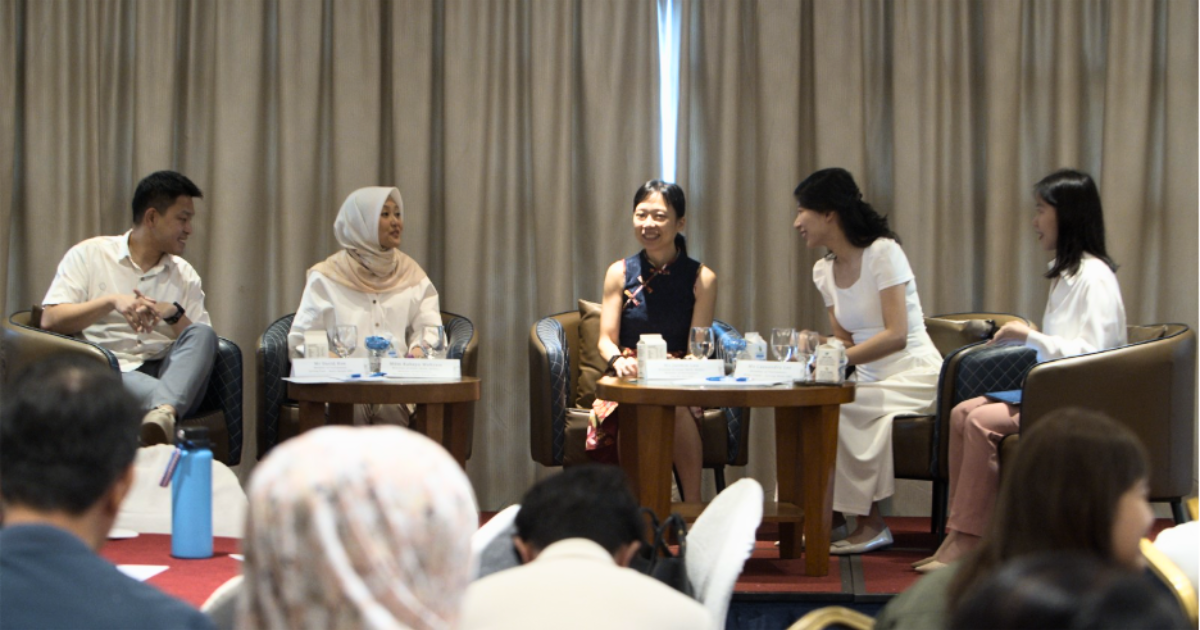
The panel featured MOS Rahayu Mahzam, MOS Jasmin Lau, as well as MPs Cassandra Lee (West Coast–Jurong West GRC) and David Hoe (Jurong East-Bukit Batok GRC).
They talked about a common feeling among Singaporean parents: the fear that they aren’t doing enough, often made worse by seeing “perfect” parents on social media.
“The reality is that every generation will feel like it’s harder, it’s different,” said MOS Rahayu Mahzam. “Technology is catching us off guard because it’s going very, very fast.”
MOS Jasmin Lau agreed, noting that while the internet offers many tips, it also adds stress. “I follow all these accounts that teach you how to be a good parent,”she said. ” But I also feel very pressurised because every time I scroll, I feel like a bad parent.”
The struggle with mother tongue
Many parents are frustrated that their children prefer speaking English, with the reality that their mother tongue is neglected and seen only as a stressful school subject rather than a part of daily life.
MOS Lau explained that the government is making mother tongue learning more fun for children.
“Interestingly last week I asked the MOE staff to sit down with me, the experts who are doing the Mandarin curriculum,” said MOS Lau. “They showed me textbooks from 1983, all the way until now. The materials are way more fun now, every textbook has some activities, lots of cartoons, compared to the earlier versions that many of us had.”
Children still need to learn a basic amount of the language to be successful in the future. She suggested making the language part of daily routines.
“If you want to buy something, you must say it in Mandarin,” said MOS Lau, describing how she teaches her children at the grocery store. “It’s inserted into our daily lives at points where they are most engaged.”
For MOS Rahayu, mother tongue learning can often be overlooked by parents who are time-poor.
“There are some advantages of the Malay language. It is romanise,so reading and speaking becomes a little bit easier and actually statistically in the Malay community we do still speak the language at home, so there is a bit of an edge there,” said MOS Rahayu.
“But sometimes, there is little motivation amongst parents and families to use it and especially when you’re thinking of all the different subjects then it sometimes gets de-prioritised.”
Using AI wisely
Parents also shared worries about Artificial Intelligence (AI). One attendee mentioned how her daughter used AI for homework but got the wrong answer instead.
“Many of the questions that I hear about AI is if you’re allowing the children to use AI then what about another child who uses it for exams for shortcut?‘What if my child loses out because I don’t know how to use AI,’”said MP Cassandra Lee.
“So the issue is that the technology is moving very fast, sometimes faster than the parents can keep up and I hear from the ground that parents are also learning at the same time.Which is why it feels all the more challenging,” she continued.
MOS Lau clarified that schools are not just giving kids tools like ChatGPT. Instead, they are teaching “AI literacy” starting in Primary 4. “It doesn’t spit out the answer,” said Jasmin Lau, describing the school’s AI tool. “It spits out more questions at the child to force the child to learn.”
The panel agreed that while the government sets up rules, parents provide the “compass” for their children. “Parenting is like a math textbook where you can’t flip to the last page to see the answer,” said David Hoe.”Values will be that light to show the way.”
Be kind to yourself
Cassandra Lee noted that the community and government are “journeying together” to help families adapt to these changes.
In closing, the leaders reminded parents to be easier on themselves. “The first practical tip is to tell yourself you are not a bad parent,” said Jasmin Lau. “Have some confidence that you are doing your best for your child, and that itself is a good start.”