The PAP Government stood-up the Homefront Crisis Ministerial Committee, soon after hostilities in the Middle East escalated in February 2026. The HCMC responds to the impact of any homefront crisis or emergency, and was formalised after the SARS outbreak in 2003.
This July 2003 article from the Petir archives shows how our response to emergencies was developed through the baptism of fire that was the SARS crisis. As true today, as it was over twenty years ago, unity, effective action and trust in difficult times is a PAP Government tradition.
Jul 2003
Once the danger posed by SARS became clear, Prime Minister Goh Chok Tong mobilised the entire Government machinery to support the Health Ministry.
His biggest concern at first was the large number of Singaporeans being infected, mainly in hospitals.
“But at the same time, life had to go on. For example, we had to decide how long the schools should close, and how we could avoid closing down our tertiary institutions altogether should there be a SARS-suspect case amongst their students,” he says.
Once there was a better understanding of how the disease was transmitted, he realised that the problem went beyond hospitals and schools and that the virus could spread to the community, he says.
Realising that SARS could have a grave impact on the economy, he decided that the disease had to be fought on all fronts – a total defence strategy.
Hence, on Apr 7, he formed the Ministerial Committee on SARS, headed by Home Affairs Minister Wong Kan Seng, to take a comprehensive look at the impact of SARS on every aspect of the economy and society. The nine-member committee includes Ministers Lee Boon Yang, Mah Bow Tan, Lim Hng Kiang, Teo Chee Hean, Lim Swee Say and the junior Ministers Tharman Shanmugaratnam, Khaw Boon Wan, Balaji Sadasivan, Vivian Balakrishnan and Ng Eng Hen.
Their job involves developing action plans to deal with all possible scenarios that could arise, such as if most residents in an apartment block were affected.
Deputy Prime Minister Tony Tan says that the battle against SARS highlights the importance of meeting the threat head-on and dealing with the disease comprehensively, transparently and nationally.
“Under the leadership of Prime Minister Goh Chok Tong, the Government machinery sprang into action, implementing severe, even draconian measures to contain the spread of SARS in Singapore,” he notes.
Another lesson learnt is the need for co-ordination and co-operation among our Ministries and Government agencies to mobilise all our resources in order to mount a multi-faceted attack against this menace to our society.
Instead of treating SARS as primarily a public health issue, the Government made the fight against SARS a national priority and set up a Ministerial Task Force as the SARS Combat Unit.
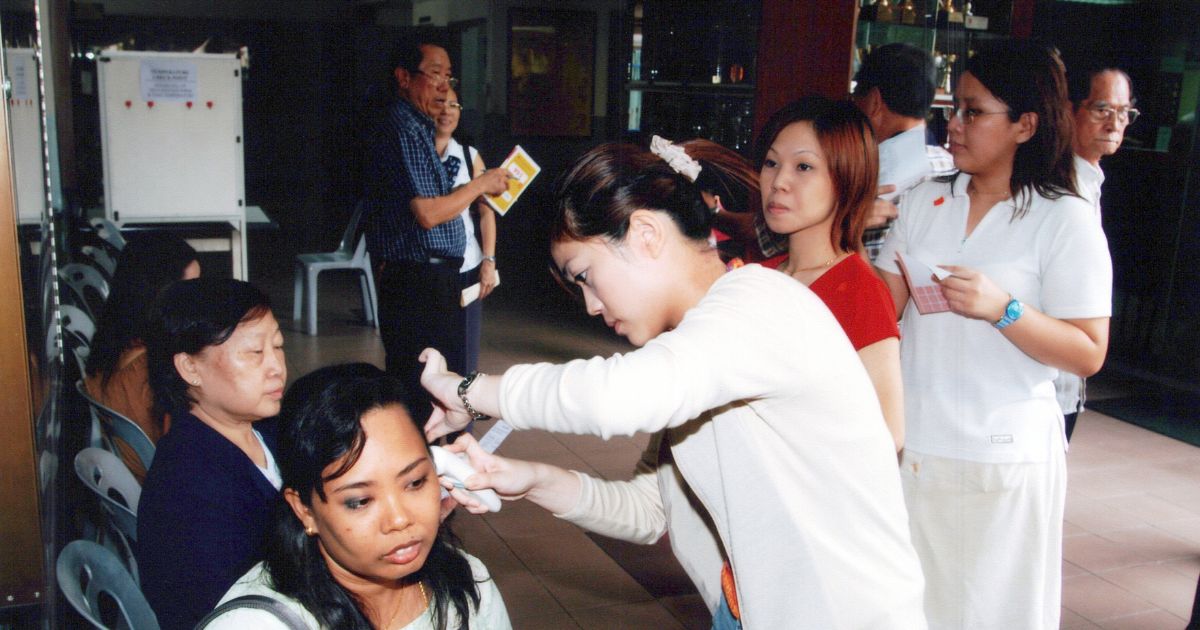
The third lesson DPM Tan drew from the SARS battle is the need to rally the ground. Ministers, Members of Parliament, and community leaders fanned out to all the constituencies to dispel misconceptions or panic about SARS and to advise Singaporeans about the measures they should take to help combat the virus.
“As a result, we were able to contain the disease effectively without causing panic or undue anxiety in our people,” says DPM Tan.
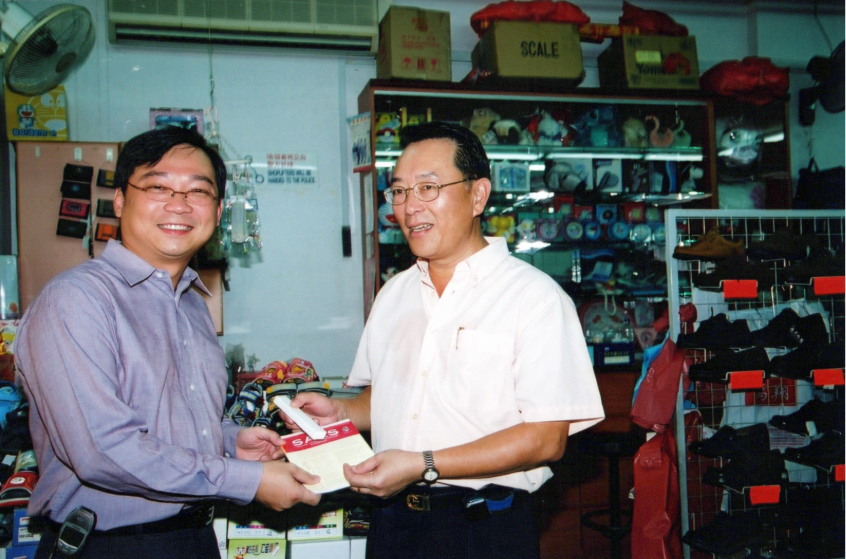
DPM Gan Kim Yong (then MP for Holland-Bukit Panjang GRC) giving out thermometers to residents during a SARS awareness outreach walkabout.