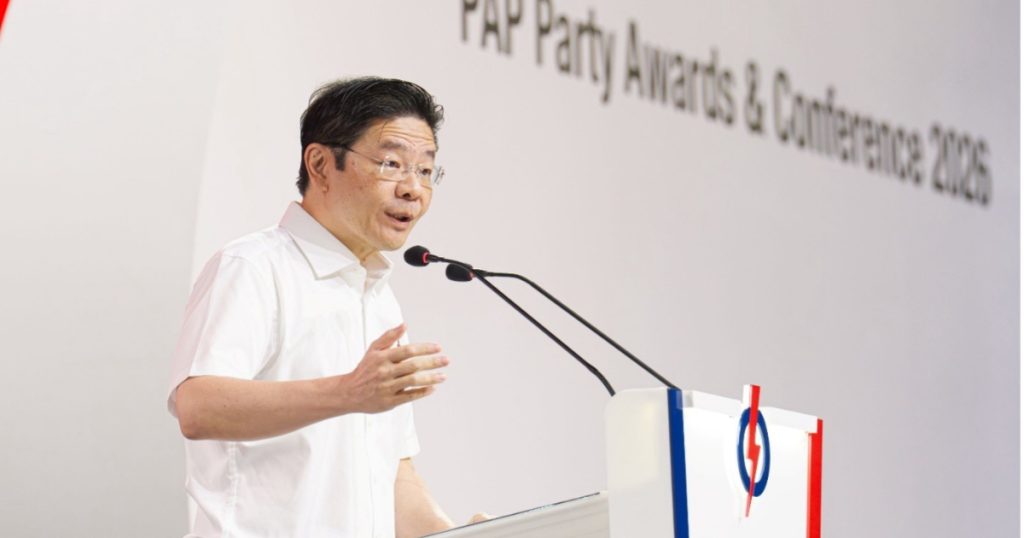
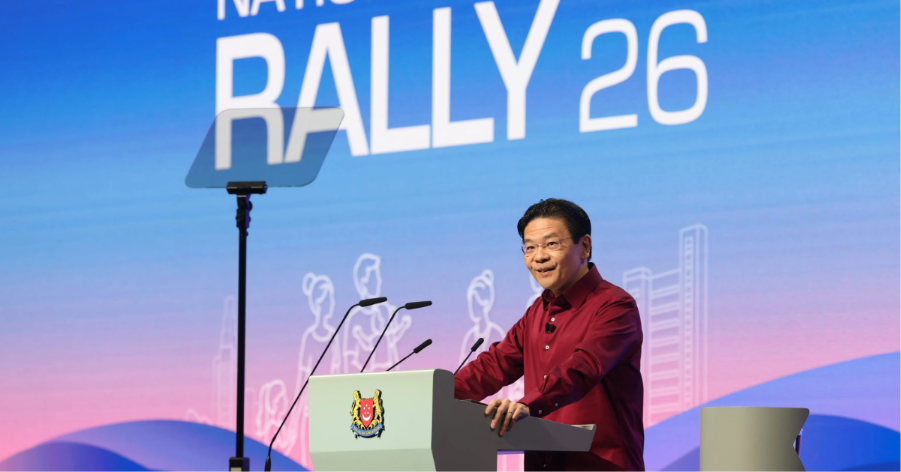
“Singapore’s future will only be as strong as the families that build it,” said Prime Minister Lawrence Wong at last night’s National Day Rally (Aug 23).
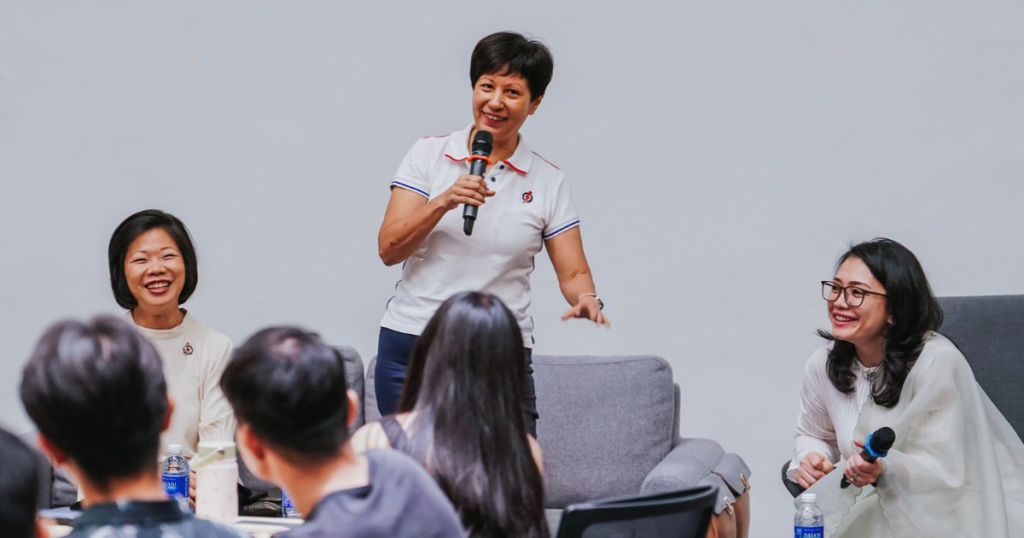
This belief is what underscores the new set of sweeping measures to support families. They include new policies that will give parents more time with their children, reduce the cost of childraising and make it easier for families to secure homes. This series of initiatives is a start, with more to come as the Marriage and Parenthood Reset Workgroup, chaired by Minister Indranee Rajah, continues its work.
The PAP government is demonstrating a firm commitment to helping Singaporeans have children and raise families. Instead of concentrating help around the birth of a child, these new policies will support parents more consistently throughout their journey of raising children.
“The work is still ongoing,” said PM Wong. “We are aiming for more than incremental improvements or changes to individual schemes. We want to make a fundamental shift in how we support families.”
More childcare leave for parents
Over the years, the government has expanded parental leave, giving parents up to 7.5 months of paid leave to spend with their child during their first year. Today, it is preparing to go further. Parents will now receive more childcare leave, with the number of days increasing according to family size.
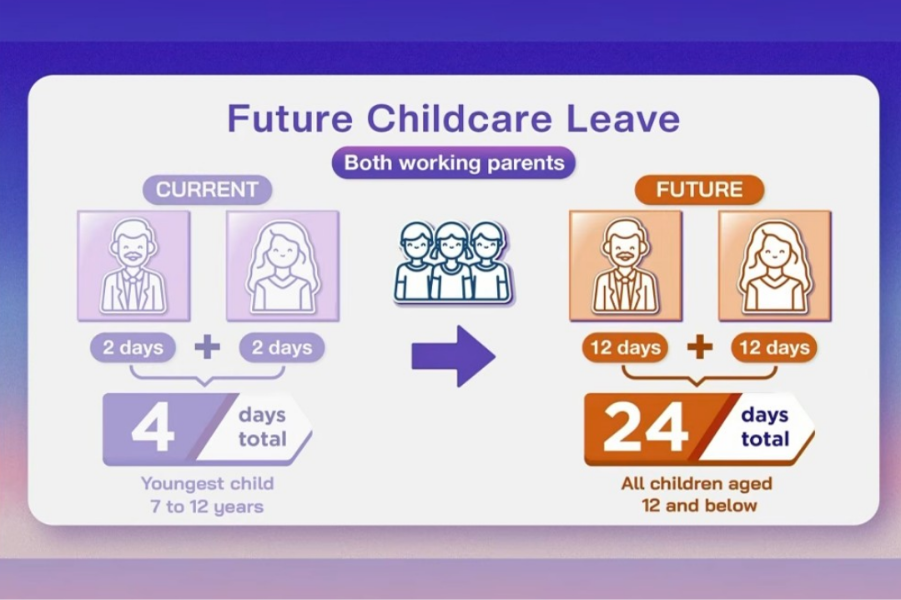
With this change, working parents will receive eight days a year for one child aged up to 12, 10 days for two children and 12 days for three or more children.
For a working couple with three primary-school children, their combined childcare leave would rise from four days today to 24 days, said PM Wong.
“This will give parents more time and much greater flexibility to care for their children.”
In addition, PM Wong announced that the government will cover the cost of all statutory child-related leave, up to the reimbursement limit, to reduce the burden on employers.
He also urged employers to be more supportive of employees who are parents by making sure that parenthood did not become a career disadvantage.
“Support parents in your organisations and give them confidence to take the leave they are entitled to,” he said. “Help them settle back into work afterwards.”
Greater financial support
Under the new arrangement, birth order will no longer determine the amount of financial support a child receives.
“Every child will receive the same level of support […] not just at birth but throughout the years as children grow up,” said PM Wong.
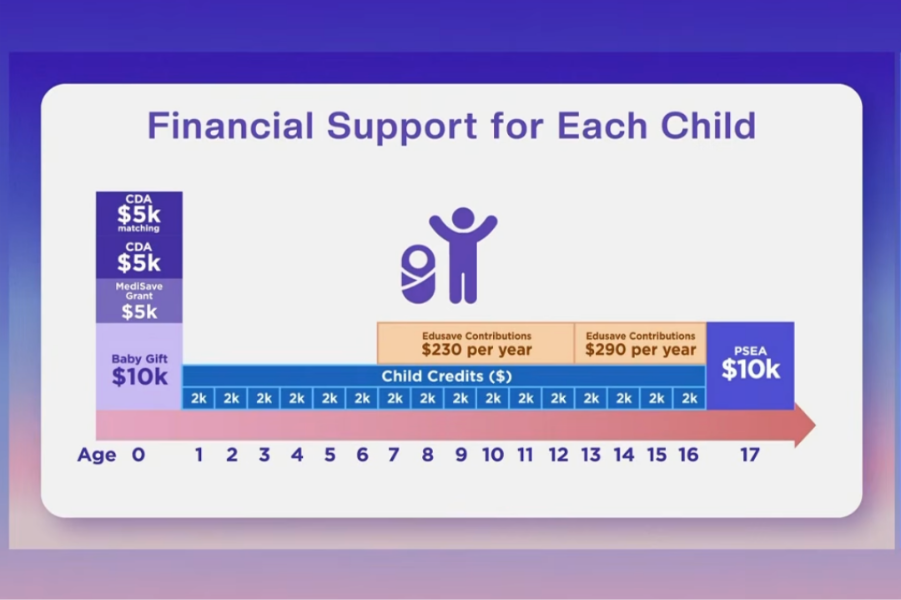
Starting from birth, every newborn will receive a S$10,000 Baby Gift, a S$5,000 Medisave grant, and S$ 5,000 in their Child Development Account, with up to another S$5,000 available through dollar-for-dollar matching.
From age one through 16, children will receive S$2,000 in annual Child Credits, together with Edusave top-ups during primary and secondary school. At 17, they will receive another S$10,000 in their Post-Secondary Education Account.
“Taken together, every Singaporean child will receive almost $70k in direct financial support as they grow up,” said PM Wong.
Lowering childcare fees to $150 a month
In his speech, PM Wong also addressed childcare costs.
While monthly full-day childcare fee caps have been lowered to $610 this year (compared to $720 in 2021), PM Wong recognised that this amount can still be “substantial”.
As such, he has signalled his intention to bring full-day childcare fees down to S$150 a month, and infant-care fees to S$300.
These lower fees will apply to every Singaporean child, regardless of household income, said PM Wong. Meanwhile, lower-income families will continue to receive additional subsidies and pay even less.
However, these changes will take several years because Singapore first needs to expand its network of government-supported operators.
“We will need a few years to get there,” said PM Wong, adding that the aim was for quality preschool to be “within every family’s budget, and easily accessible in every neighbourhood.”
Helping families secure a home
Housing policy will also be adjusted to reflect the fact that Singaporeans are marrying later and may have higher incomes by the time they seek a home.
The income ceiling for BTO flats will rise from S$14,000 to S$16,000 per month, and the ceiling for executive condominiums will increase from S$16,000 to S$18,000 per month.
First-time families with children will also receive an additional ballot chance for each child they have or are expecting.
“So, the more children you have, the more ballot chances you will receive –because we want to help growing families secure a home sooner,” said PM Wong.
Despite family policies taking centre stage at this year’s NDR, PM Wong acknowledged that the decision to have children (or not) is ultimately “a deeply personal one”.
“Policies alone cannot make this happen. But if you choose to have children, the Government will stand with you. We will provide more support, and over more years,” said PM Wong.
Staying open in a turbulent world
As Singapore navigates an increasingly turbulent world, providing families with greater support is one part of a broader mission to “steady the ship” and build a brighter future.
In his speech, PM Wong called on Singapore to harness new technologies, such as AI at work and to keep our economy open, especially in a world that is more contested and unstable than before.
“Our response cannot be to retreat and turn inward. We will reach out to more partners, make ourselves even more relevant, and create more opportunities for Singaporeans,” said PM Wong.
Planning for the next century
In fact, creating new options for this generation and the next is why Singapore is forging ahead with plans to transform our physical landscape, starting with our outer islands.
The government plans to merge several islands south of Jurong Island into a single, larger island, which could eventually host advanced manufacturing, power infrastructure, and space for the armed forces. Like Jurong Island, the project could shape Singapore “for the next 50 years and beyond”, said PM Wong.
Sentosa’s western shoreline, with its distinctive coastal cliffs, will be made accessible to the public. Pulau Brani, an island right by Sentosa, will be transformed into a new resort and other attractions. These plans to transform our southern waterfront will not only bring Singaporeans closer to nature but give us more to see and do.
Singapore will also study the feasibility of undersea tunnels to Pulau Tekong, avoiding the busy shipping lanes that make bridges impractical.
“All of these projects will take decades to complete. They will require resources, planning, and investment over many terms of government,” said PM Wong.
As a small nation with little land and few resources, Singapore has always had to think beyond the immediate horizon to secure its future. The policies laid out in this year’s NDR reflect our approach to governance – that is to plan early, build ahead and leave the next generation with more options than the last.
“We plan fifty, seventy, even one hundred years ahead. And we plan with every Singaporean – born and not yet born – in mind. That’s how every generation has strengthened Singapore.”
“That is how our children and grandchildren will inherit a Singapore with more space, more opportunities, and even greater possibilities than what we have today,” said PM Wong.
Concluding the rally, PM Wong shared that while there will be difficulties we cannot foresee, he remains confident that Singapore will prevail.
“We cannot know what challenges lie ahead. But if we stay united, keep faith with one another, and hold fast to the values that have brought us this far, I am confident we will rise to every challenge…and build a brighter future and a stronger Singapore.”