
Members of Parliament from the People’s Action Party welcomed the marriage and parenthood measures announced during the National Day Rally. However, they emphasised the need for mindset changes and partnerships with stakeholders to ensure successful implementation.
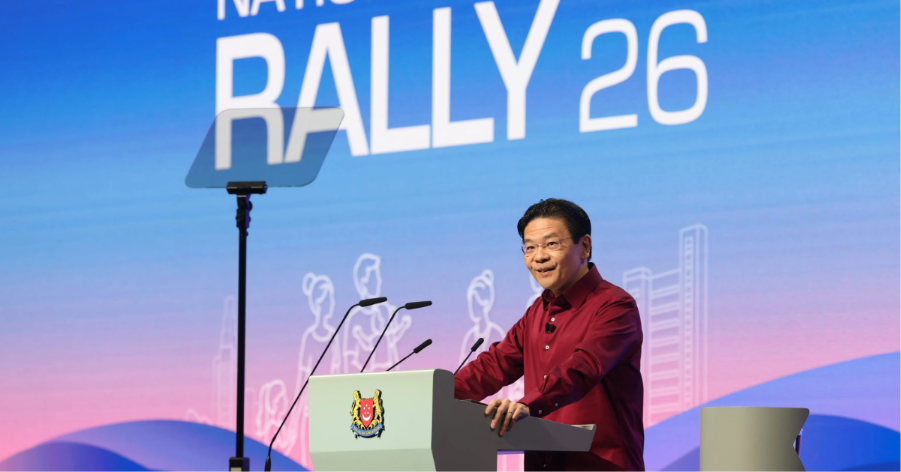
Prime Minister Lawrence Wong on Aug 23 announced policy changes including additional childcare leave, reduced pre-school fees, and more financial support totalling nearly $70,000 per child from birth to age 17. This includes a new SG Child Support Package.
PAP MPs told Petir that they are glad to see these policy moves, having long championed these support measures in Parliament.
Valerie Lee, MP for Pasir Ris-Changi GRC, described the latest policy changes as an overhaul of the system’s financial support measures. According to the MPs, the changes demonstrate that the PAP Government has been listening to Singaporeans’ concerns.
Shawn Loh, MP for Jalan Besar GRC and father of four children aged five to 13, called the enhanced financial support and reduced childcare and infant care fees “bold moves.”
He has previously proposed in Parliament that basic childcare, infant care, and student care be free for all children, arguing this would give parents “peace of mind” and ensure raising children is no longer a “barrier to having more children.”
However, Mr Loh noted that implementing increased childcare leave at work places may not be straightforward. Employees may hesitate to use all their leave, requiring a “mindset reset” among both employees and employers.
He also expressed concern that parents with multiple young children may be less attractive to employers.
“Even though the government is paying for [childcare leave], [employers] would factor the fact that their employees will be away from work for longer periods,” he explained. “Prospective employees, particularly parents with young children, might find it more difficult to look for jobs.”
Cassandra Lee, MP for West Coast-Jurong West GRC, said the additional childcare leave for parents is a significant step forward, but success requires partnership from employers and community partners to make it truly accessible.
“Not just leave on paper, but ensuring all parents can actually take the leave and benefit from the flexibility to have quality time with their families,” she said.
Ng Shi Xuan, MP for Sembawang GRC, said that the increase in childcare leave for parents will be borne by the government, which will be of great relief for business owners like himself.
“I was thinking, oh wow, that’s a heavy cost to business. But the government will cover these childcare leaves, and I think that this is a big assurance for business owners, and we will be supportive of the schemes going forward.”
Labour MP Yeo Wan Ling (Punggol GRC) said that while more childcare leave is a meaningful step, workplace culture matters just as much.
“NTUC Women & Family, our unions, and PAP Women’s Wing will continue to work with tripartite partners to ensure parents can use these provisions with confidence,” she said in a Facebook post.
Nadia Ahmad Samdin: We need to mitigate impact of reclamation on S’pore’s ecologically rich marine life
During the rally, PM Wong also announced that a new western island will be formed in the coming decades by merging several islands lying to the south of Jurong Island.
This cluster of islands comprises Pulau Semakau, which houses Singapore’s offshore landfill; Pulau Bukom, where Singapore’s first refinery still operates; Pulau Sudong and a few other smaller islands.
Land will also be reclaimed to better connect Sentosa and to Pulau Brani, where NTUC’s new Downtown South resort will be built.
Singapore is also studying the feasibility of building undersea tunnels to connect Pulau Tekong, its largest outlying island, to the mainland.
Nadia Ahmad Samdin, MP for Ang Mo Kio GRC and Deputy Chairperson of the Government Parliamentary Committee for Sustainability and the Environment, said that while reclamation has always been part of Singapore’s toolkit, the country must be creative yet judicious about space.
She noted that several major projects—the development of the western island, the linkage between Sentosa and Pulau Brani, and possible undersea tunnels connecting Pulau Tekong to the mainland—will impact Singapore’s marine life.
“What is unseen is not unimportant. Very few have had the privilege to witness our thriving marine ecosystem, especially around the ecologically rich western islands, for example, around Semakau, Jong, and Raffles Lighthouse,” she said.
Ms Nadia hopes the government will study the system when preparing Environmental Impact Assessment (EIA) reports and keep in mind that Singapore’s waters and habitats are interconnected.
“I hope that nature will influence the design of our reclamation,” she said. “We’ve learnt so much from past experiences around Jurong, Semakau, the ongoing Long Island project, and others, [lessons we can apply] before the design impacts nature.”
MP: Lifting of cap on screenings of films with dialect shows that government is listening
MPs welcomed the removal of screening limits for films with dialect content, provided they include Chinese subtitles and offer a Mandarin-dubbed version. The updated dialect guidelines take effect in September.
Valerie Lee noted that she and many PAP MPs have championed loosening restrictions on dialect movie screenings in Parliament following the Chinese film Dear You, which sparked lively discussions in Singapore recently.
“Even though only seven per cent of Chinese families speak dialect now, lifting this policy shows the government is listening and trying to engage a wider audience segment.”
Charlene Chen, MP for Tampines GRC, called the relaxation of measures timely. During last year’s National Day Rally, PM Wong announced that the government would conduct a leadership programme for Chinese community leaders. As the trainer for a master class for the participants of the programme, she shared ideas on rebranding clan associations.
“There’s a lot of interest in our dialect groups. I hope we can do more to support our clans. They want to reach out to youth to preserve our heritage, and we should give them our full support.”
MP: Platform operators must create safe spaces for youths to navigate online
Another key priority for the Republic is requiring social media platforms to implement and enforce robust, reliable checks that genuinely protect children.
Most social media platforms set a minimum age of 13 but largely rely on users to self-declare their ages. Singapore will prioritise making social media safer by design and will consider additional restrictions on platforms with inadequate safeguards, PM Wong said.
Dr Chen expressed concern about the explicit, damaging, and dangerous content online. She hopes the government will hold platform providers more accountable.
“I hope platform operators will create safe spaces for our youths to navigate online. Age verification would be very difficult. We’ve seen other countries try, and it’s not simple,” she explained. “I hope the platforms will tighten these measures and that our government will push them to do so.”
Separately, Mr Ng said that the PM mentioned agentic artificial intelligence during the rally. He is keen to explore how agentic AI could help small businesses grow without requiring additional workers.
“I hope we can have more input and more support for small and medium businesses in the longer term.”
According to Mr Loh, two key factors underlie many of the NDR announcements: the desire to plan for the long term, and the ability to do so.
“Long-term planning requires both the desire and the ability,” he said, pointing to the Prime Minister’s discussion of reclamation projects 50 to 100 years into the future.
“The ability to plan for the long term depends on the resources that we have in the country, and the trust and support of all Singaporeans. This enables each government term to build upon the investments and policies of previous terms.”